Our Honey
Just as in other areas of agriculture, most beekeepers have adopted an industrial model. Pesticides are used within the hive to ‘control’ parasitic mites and antibiotics are fed to control various pathogens. We do not follow this model.
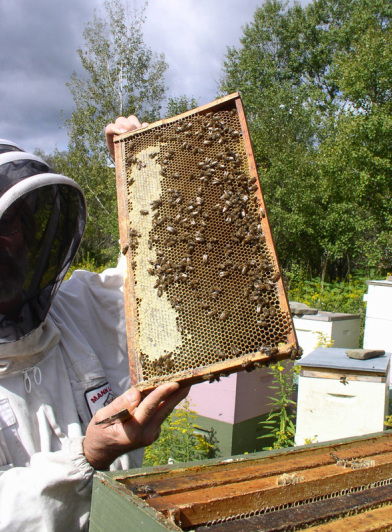
We use no pesticides or antibiotics. Instead, we raise hardy, resilient bees. To help them we’ve also moved our apiaries to ‘wild’ sites, away from the conventional farms which have grown increasingly toxic. And we have adjusted our management to always try to meet the needs of the bees.
The bees make our honey in the southern tier of Western New York.
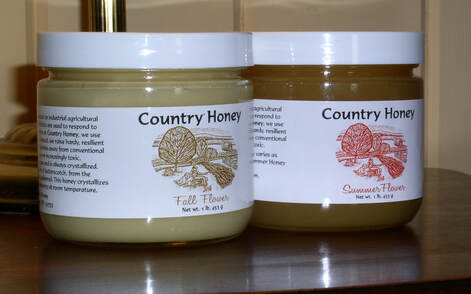
Our fall honey is packed raw and is always crystallized. The flavor is quite consistent (butterscotch?!) as golden rod is always the dominant floral source. The bees always blend in a little aster honey with the golden rod. The aster prompts this honey to crystallize quickly to a fine, spreadable consistency if kept at room temperature.
The summer honey is heated to no more than one hundred and ten degrees and strained through a filter cloth. This is our liquid honey. The flavor of our summer honey varies according to the plants visited by the bees, which may include dandelions, honeysuckle, autumn olive, wild berries, locust, sumac, boneset, basswood, and joe-pye weed.
We use no pesticides or antibiotics. Instead, we raise hardy, resilient bees. To help them we’ve also moved our apiaries to ‘wild’ sites, away from the conventional farms which have grown increasingly toxic. And we have adjusted our management to always try to meet the needs of the bees.
The bees make our honey in the southern tier of Western New York.
Our fall honey is packed raw and is always crystallized. The flavor is quite consistent (butterscotch?!) as golden rod is always the dominant floral source. The bees always blend in a little aster honey with the golden rod. The aster prompts this honey to crystallize quickly to a fine, spreadable consistency if kept at room temperature.
The summer honey is heated to no more than one hundred and ten degrees and strained through a filter cloth. This is our liquid honey. The flavor of our summer honey varies according to the plants visited by the bees, which may include dandelions, honeysuckle, autumn olive, wild berries, locust, sumac, boneset, basswood, and joe-pye weed.